
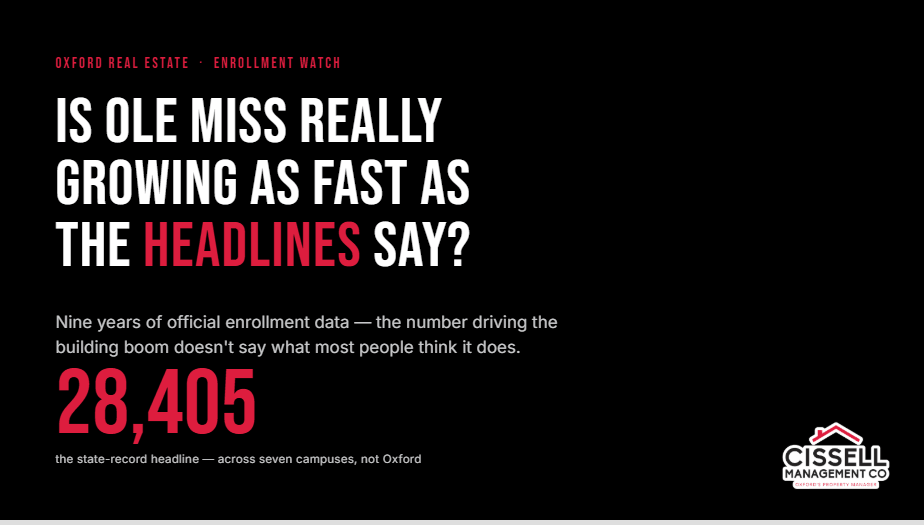
It seems like every fall we get the same headline in Oxford. Record enrollment at Ole Miss, another year, another record. Those headlines always fuel the frenzy, and I have people ask me what it means. I usually want to know the story the headlines aren't telling, so I pulled the actual enrollment data going back to 2015, straight from the state's official fact books, and the real picture is more interesting than the headline, and it matters a lot if you own property here or you are watching all the building going up around town. There is a lot of money moving on the strength of that headline right now. Developers are building, and buyers and investors are pouring money into Oxford real estate off the hype and frenzy around record growth, and most of them have not stopped to check whether the number driving it all actually says what they think it does.
The record 28,405 is not the Oxford number
Start with the number itself. This past fall the university announced 28,405 students, a state record. That number is real, but it counts seven campuses, and one of them is the Medical Center two and a half hours away in Jackson, which by itself is 3,183 students, residents and fellows. None of those people are looking for a place to live in Oxford.
Pull the Medical Center out and the University of Mississippi side comes to 25,222. Most of that is Oxford, but it also folds in the regional campuses in Tupelo, Southaven, Booneville, and Grenada. The state publishes the Oxford campus on its own, and that number is 25,086. The regional campuses barely move it. They are small; they have shrunk from about 1,500 students in 2016 to roughly 660 today, and almost all of those students take Oxford classes too, so they are already inside the 25,086. That is the number I use for the rest of this.
But even 25,086 is a ceiling, not a count of who lives here. It counts students taking classes on the Oxford campus, not students renting a place in town. About 500 of them are also enrolled at a regional campus and are most likely living in Tupelo or Southaven, not Oxford. Others take everything online from wherever they already are, and the state does not separate that group out. So the number of students looking for a place in Oxford sits somewhat below 25,086.

Ole Miss enrollment: real growth, but mostly recovery
People tend to paint Ole Miss and Oxford as if they're an anomaly with only an upward trajectory. But that's not the case. The Oxford campus hit a record high with about 20,500 students in 2016. Then it fell, over four years, to about 18,400 in 2020, a loss of roughly 2,100 students. It did not climb back to its 2016 level until 2023. So a lot of what gets celebrated as record growth from 2020 to 2025 is really two different things. From 2020 to 2023, the university was just digging out of a hole and getting back to where it had been in 2016, and only after that, in 2024 and 2025, did enrollment actually push past the old peak.

I think when people picture Oxford today, they picture a student body that is enormously bigger than it used to be, and the truth is the Oxford campus is about 4,600 students bigger than it was in 2016, over nine years. That is real growth, but maybe less explosive than people picture.
Almost all the Ole Miss enrollment growth is out-of-state
When you look at where the new students came from, it is striking. On the Oxford campus, in-state enrollment has not grown at all. It has gone backward, from about 11,000 Mississippi students in 2016 to about 10,400 now. Every bit of the growth is out-of-state students, who went from about 9,400 to about 14,700, and they now make up nearly 59 percent of the Oxford campus. That is a real achievement by the recruiting office, but it also means Oxford's growth depends on convincing families in Texas, California, Tennessee and Georgia to keep choosing Ole Miss, not on anything happening here at home.

Last month he was back in front of the state's IHL board, which oversees the public universities, reporting another record: more than 46,500 applications for this fall. This time, he did not put a number on the class. The university has also quietly set aside the freshman cap it had publicly considered a year ago, with its enrollment chief saying there are no plans to implement it. They have not said they are worried about a decline, but their reason for not capping points that way. Out-of-state students pay more than double what Mississippi students pay, and with the pool of college-age kids about to shrink, Ole Miss is not going to turn students away on purpose. Applications have more than doubled since 2021, from about 19,500 then to more than 46,500 for this fall, and Ole Miss admits about 97 percent of the people who apply. So the size of each class comes down almost entirely to how many admitted students actually choose to move here, and that share has been sliding. Applications do not fill apartments. Students do.

Why a record year and a shrinking freshman class can both be true
If the freshman class got smaller, how did enrollment hit a record? It is a fair question, and the answer is the most important thing on this page.
Enrollment is not a measure of this year's demand. It is a cumulative headcount of everyone in the building. In 2025, the number of new students arriving, the entering freshman class, fell by 508, from 5,972 down to 5,464. But the growth of the classes Ole Miss brought in during 2023 and 2024 was larger than the outgoing classes. That is how Oxford still finished the year 1,228 students ahead at 25,086 and called it a record.

So the record is real, and it is also an echo. It is being produced by students who were recruited two and three years ago, not by the students showing up now. Enrollment can keep setting records for another year or two on that momentum alone, even while the entering class shrinks underneath it.
That is the part worth sitting with if you are making a decision on the strength of the headline. The number everyone is quoting is a rear-view mirror.
On top of that, the whole country is heading into what people in higher education call the demographic cliff, which is just a smaller number of college-age kids coming through, the result of fewer births around the 2008 recession. The South holds up better than most of the country, and Texas, one of Ole Miss's biggest feeder states, is actually growing. But Mississippi's own high school graduates are projected to drop about 16 percent by 2041. Oxford does have a tailwind, but it is also getting harder to count on.

What it means for Oxford real estate and student housing
Now put that next to what is going up around town. These are my own working numbers, and they fall into three buckets. At the end of 2025 there were about 7,000 beds already under construction in the city, with dirt moving on them. Then there is the university itself, which has two new on-campus housing projects in the works with Greystar that together add about 2,800 beds, the first about 1,300 beds on the old Kincannon site due by fall 2027, and the second about 1,500 beds near the law school due by the summer of 2028. On top of that, roughly 2,000 more beds have been approved. Add the three together and you are looking at somewhere around 12,000 potential new beds by fall 2028, and that is just inside the city limits and on campus, not the county. I say potential because an approved project is not a built one. A developer can sit on a plan, or delay or shelve it if the market starts to look saturated, so the number that actually gets built could come in lower. It could also come in higher, because this only counts what we know about today, and there could be more projects in the works that have not come through approval yet. The majority of it is student townhomes and condos, but it also includes million-dollar condos and family homes that are not strictly student housing.
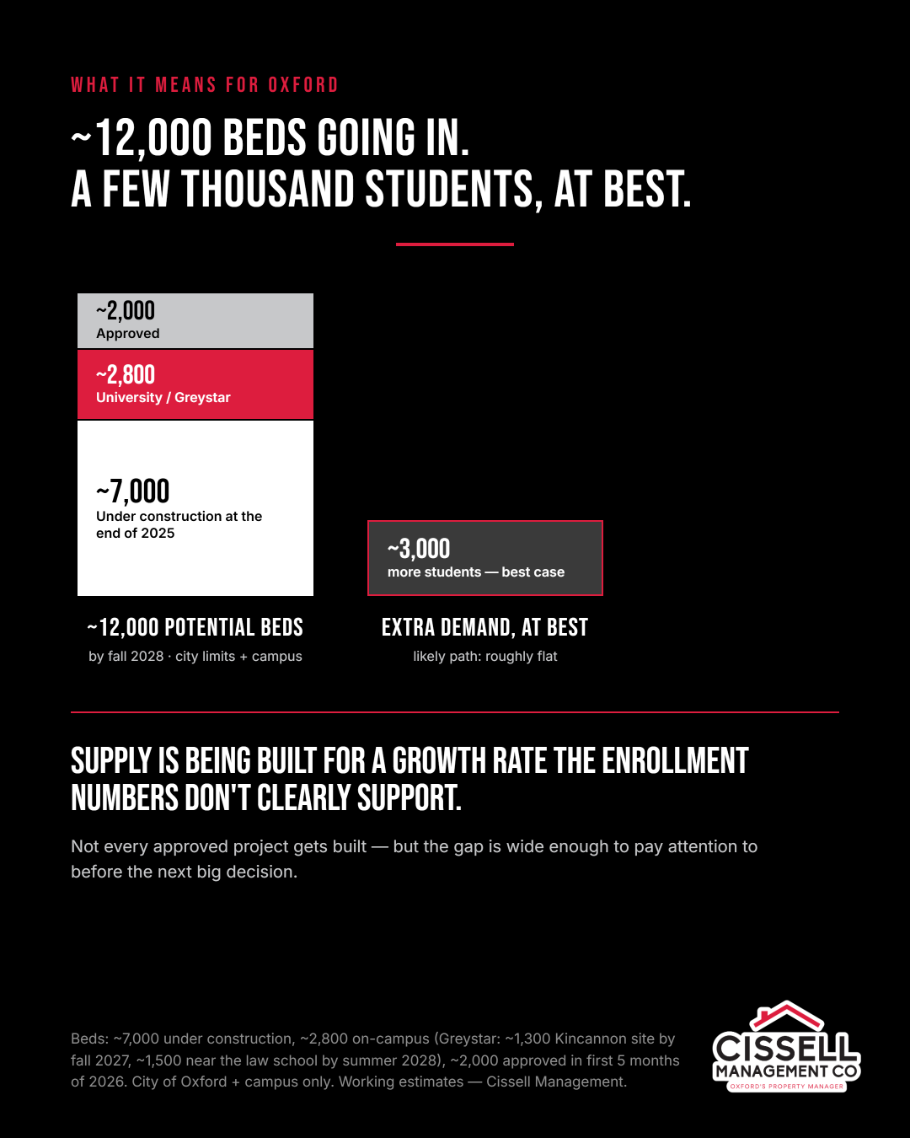
Even on a very good run for the university, the kind where they land the biggest freshman classes they have ever had and hold them, you are talking about a few thousand more students by 2028. The more likely path is roughly flat, and the downside is fewer students than today. Put a few thousand new students, at best, against roughly 12,000 new beds, and the math gets your attention. I am not saying Ole Miss is shrinking or that the sky is falling. I am saying the supply going into the ground is being built for a growth rate that the actual enrollment numbers do not clearly support.
Now the fair objection, and it is a good one. Oxford is not only a college town, and it is not standing still. People move here who are not students. Retirees, remote workers, families, second-home buyers, people who came for a football weekend and never really left. That is real demand, and none of it shows up in an enrollment number. So the honest version of the question is not whether Ole Miss can fill 12,000 beds. It is whether Ole Miss plus a growing city can. I did not want to answer that with a guess, so I'll do my best to pull the city's numbers the same way I pulled the university's.
This is the kind of thing we pay attention to at Cissell Management, because the people who own rental property here are the ones who carry the risk when supply runs ahead of demand. If you own a place in Oxford and you want a straight read on what the market is actually doing, not the headline version, that is a conversation we are always happy to have. Look at the whole picture first. The big decisions are too expensive to make off one number.
So that is where I am taking this next. How fast is Oxford actually growing, and does that growth close the gap? After that, what all this supply is already doing to what owners can charge, because that part has started.
To read the next part in this series: Is Oxford, MS Growing Fast Enough to Fill All the New Housing?
Sources: Mississippi Institutions of Higher Learning Enrollment Fact Books (2015 to 2025). Oxford campus figures are IHL's published On-Campus Headcount Enrollment for the University of Mississippi, which excludes the Medical Center. Regional campus figures are IHL's off-campus duplicated headcount, which means most regional students are also counted in the Oxford on-campus number; about 500 of the 25,086 are regional dual-enrollees. IHL does not publish a separate count of students who take all their classes online, so the Oxford on-campus figure should be read as a ceiling on local housing demand. Freshman application, admission and enrollment figures for 2015 to 2024 are from IPEDS / the UM Common Data Set (first-time, first-year students). Chancellor Boyce's 6,300 to 6,500 freshman projection and the "over 40,000" application figure are from his March 2025 remarks to the Associated Student Body, as quoted by The Daily Mississippian; the university's enrollment chief, Eduardo Prieto, later said there are no plans to implement a cap "at this time." The university's reasoning for not capping, including the out-of-state tuition math and the shrinking applicant pool, is reported by The Daily Mississippian ("Why the university doesn't 'just accept fewer students'"). The 46,500 application figure is from Chancellor Boyce's June 2026 report to the IHL Board, as reported by Magnolia Tribune and the Mississippi Monitor; the university has not stated whether it counts freshman applications only. Demographic projections are from WICHE. The two on-campus housing projects (about 2,782 beds total across the Kincannon-site and West Row phases, built with Greystar) are reported by REBusinessOnline, Multi-Housing News, and The Daily Mississippian. Other construction and approval figures are Cissell Management's current working estimates for the city of Oxford and the campus.