
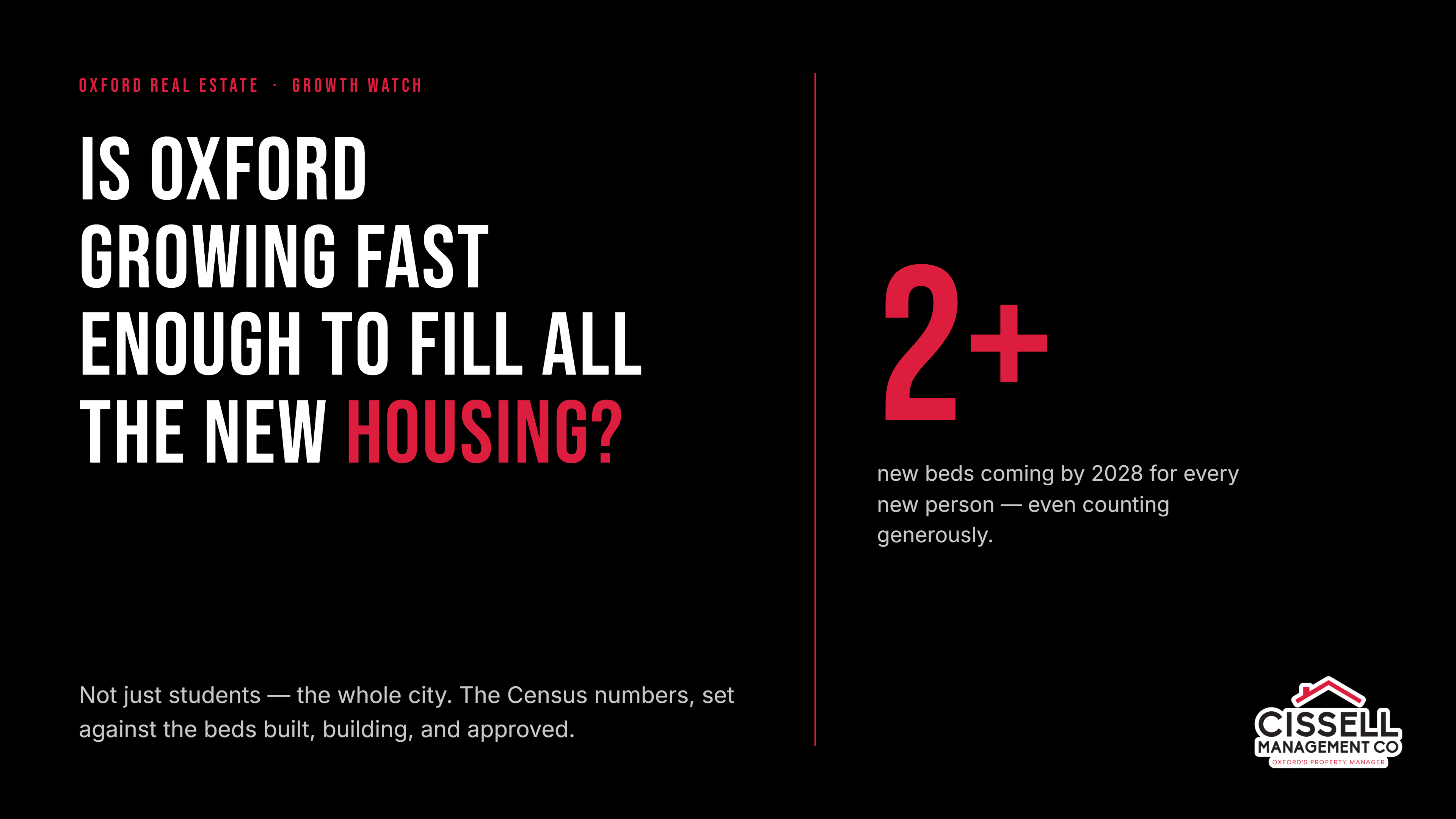
In the last piece I raised the obvious objection to my own argument. Oxford is not only a college town, so students are not the whole story. People move here who never set foot in a classroom, and they do not show up in an enrollment number. So the honest question is whether Oxford, the whole city and not just the university, can fill all that new housing. I said I would pull the city's numbers the way I pulled the university's, so here they are.
Fair warning, none of this data comes easy. The university numbers took a lot of digging through the state fact books and reconciling figures that did not line up. The city and county side piles on new problems. Boundaries move when a city annexes land, and different sources quote different numbers for the same year. A good chunk of this was reconciling numbers that did not agree until I went back to the Census itself. Here is what held up.
Oxford grew fast, but the raw count cannot be trusted
Oxford grew a lot over the last two decades, no question. But the raw city census counts are shaky for measuring it, for two separate reasons. The first is annexation. In 2018 the city carried out its largest annexation by land area, pulling in about 3,600 people and expanding its footprint from about 16 square miles to about 27. Those people were not new arrivals. They already lived there, just outside the old city line, and the annexation swept them into the count overnight. So the jump from 18,916 in 2010 to 25,416 in 2020 looks like 34 percent growth, but about 3,600 of that gain was the annexation, not new arrivals. The rest, roughly 2,900, is people who moved to town, about 15 percent over the decade.
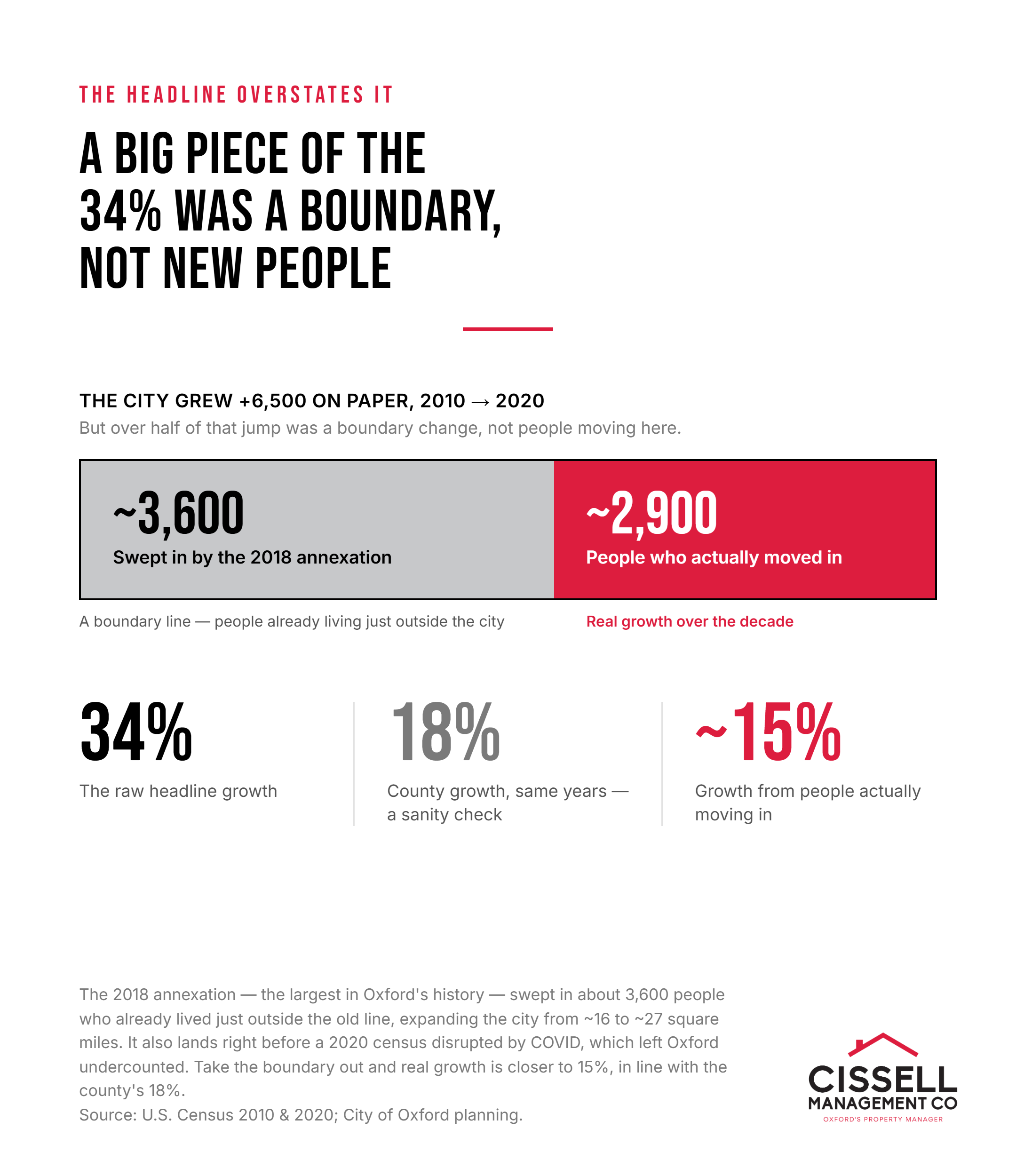
Oxford is one of the faster-growing college towns, and that ranking holds up. But for the housing question, what counts is new arrivals, the people who need a place to live, and most of the city's growth on paper is something else. The headlines say Oxford has more than doubled since 2000, and the raw census count agrees, from 11,756 to about 26,800. Two annexations are most of that, about 5,000 people in 2007 and about 3,600 in 2018, roughly 8,600 residents who already had homes and were folded into the city when it redrew its line. They never moved here and never needed a unit. The people who did move in come to about 6,400 since 2000, roughly 55 percent, almost exactly the 54 percent the county grew over the same years. The population rose, but the part of it looking for a place to live is a good deal smaller than the headline suggests.
The second reason is the 2020 count itself. Oxford's own planning department puts the population past 27,000 right after that 2018 annexation, well above the 25,416 the census recorded in 2020, and does not put much stock in that census. The timing explains it. The 2020 count came in the middle of the COVID pandemic, which disrupted census operations nationwide and left places like Oxford undercounted. Between the moving boundary and the low count, the raw city numbers cannot carry a precise growth rate.
Why the county number is the cleaner one
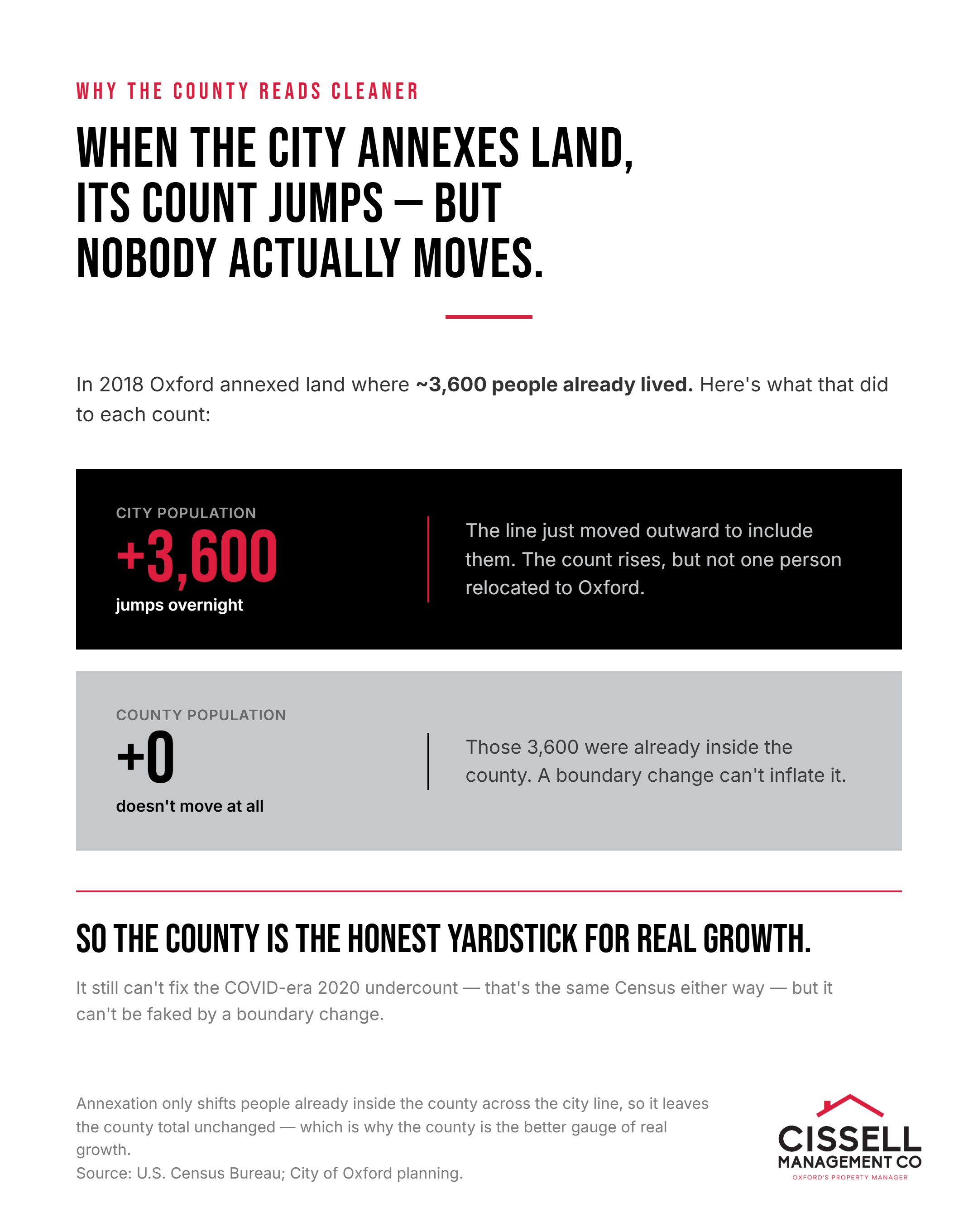
So which reading can we lean on? The county, but only so far. These are all Census numbers, the same source that undercounted the city in 2020, so the county carries that same undercount. What the county does fix is the boundary. Annexation moves people from the unincorporated county into the city, but it never changes the county total, because those people were already inside the county. So the county does not jump when the city redraws its line.
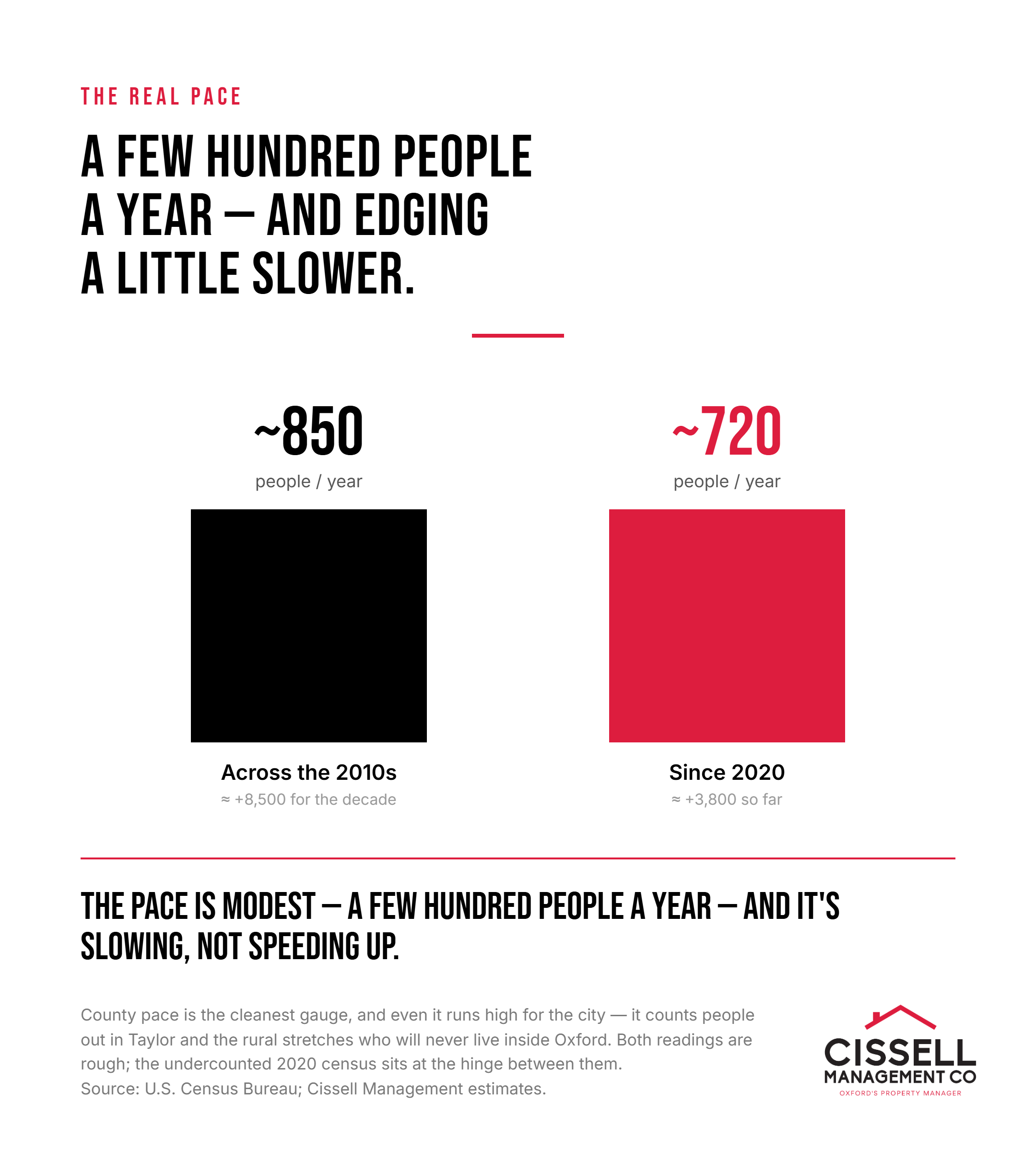
By the county's count, Lafayette added about 8,500 people over the 2010s, roughly 850 a year, and about 3,800 since 2020, roughly 720 a year. I would read both as rough, since the undercounted 2020 count sits at the hinge of them. Either way the pace is modest, somewhere between 700 and 850 people a year, and edging a little slower lately. That is the number I carry into the housing math.
The Census Bureau's latest estimate for Oxford, about 26,773 for 2025, is not a fresh count. So how is a number like that built? It starts from the 2020 census, then adds births, subtracts deaths, and folds in people moving in and out, which it measures largely from year-to-year address changes on IRS tax returns and Medicare enrollment. Since the 2020 starting point was low, the current count is probably low too. But the undercount matters less than it sounds. The total may be off, yet the number of new people added each year is tracked on its own, from births, deaths, and moves. So even if the overall count is low, the roughly 720 a year is the number I trust, and it is the one that matters for filling new housing. Unless the city comes back with different numbers, treat the totals as the best read available, not the final word. Either way the new arrivals come to a few hundred a year, not thousands, well short of 12,000 beds.
So does the growth close the gap?
It does not come close. The most generous number is the county's, roughly 700 new people a year, and even that runs high, because it counts people out in Taylor and the rural stretches who will never live inside Oxford city limits.
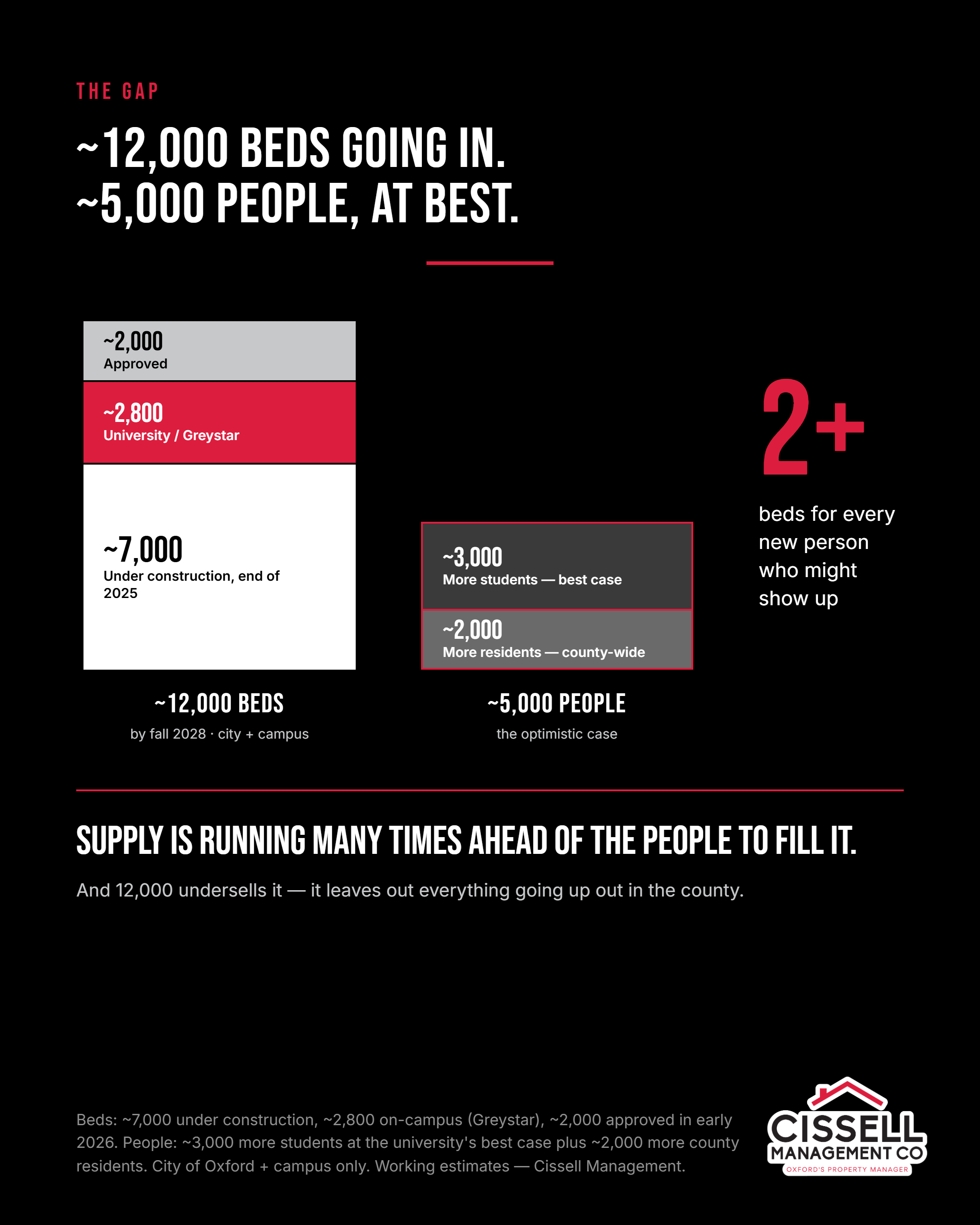
Against roughly 12,000 beds approved inside the city and on campus, the supply is running many times ahead of the people to fill it. If anything the 12,000 undersells it, since it leaves out the construction going up in the county.
The students don't close the gap either. At best the university adds about 3,000 more by 2028.
By 2028 the city and campus add about 12,000 new beds, and even counting generously the new people to fill them come to maybe 3,000 more students and, across the whole county, 2,000 more residents, so 5,000 at the very most. That is more than two beds for every person who might show up, and it is the optimistic case.
What about second homes and weekenders?
There is one more source of demand these numbers miss on purpose, and around here it is a big one. Plenty of people buy in Oxford without ever living here full time. Alumni who want a place for football weekends, parents who buy a condo while their kid is in school, families who want a spot near the Grove for a few Saturdays a year. The Census counts those owners back at their primary home, wherever that is, so they never show up in Oxford's population, and they never showed up in anything I laid out above. Over the last five years this buyer has absorbed a lot of our inventory, mostly townhouses and condos but single-family homes too, and not only around the Square.
So does that help? More than the population numbers suggest, because this buyer wants the same thing being built. Most of what is coming is townhouses and condos, not big student complexes, and that is exactly what the second-home buyer is after. But it is the most sentiment-driven money in the market, running on football and how people feel about their finances, so it pulls back first when any of that turns. I am not writing it off, but you cannot count on it to fill thousands of new units year after year.
Football is exactly the kind of thing that can turn, and right now that is an open question. We just came off the best season in program history, a 13-1 run to the College Football Playoff semifinal, and that kind of national attention pulls buyers in. Another strong year could do it again. But we lost Lane Kiffin to LSU, and he kept Ole Miss in the national spotlight as much as any coach we have had, and Pete Golding has taken over with a new staff, so no one knows yet whether the program holds at that level. I am not trying to call the season, but a good share of this demand rides on it, and that is why I would not build a plan around it.
What this means, depending on who you are

If you own rental property here, especially from a distance, price and plan around how fast the market can absorb new units, not around a headline growth number that turns out to be half boundary lines. Absorption is what pays your mortgage.
If you are buying in from out of state, the market is softening rather than booming, which is exactly when you want local eyes on a deal before you sign.
And if you rent in Oxford, the new supply is on your side. Prices started softening last year, most people just did not notice it, and with this much still coming, rents will be falling.
The bigger picture
None of this means Oxford is shrinking. It is growing. What I am saying is that the growth, once you strip out the annexation and count people only once, is not keeping pace with the supply going into the ground, and the people who own that supply carry the risk if I have this right. We watch it at Cissell Management because the owners we work for need the straight read on the market, not the headline one.
There is one more piece to this (Are Oxford Rents Dropping in 2026), and it is the one people feel in their bank account. All of this supply has to go somewhere, and it is already starting to show up in what owners can charge.
Sources: Population figures are from the U.S. Census Bureau. City of Oxford: 11,756 (2000 census), 18,916 (2010 census), 25,416 (2020 census), and about 26,773 (2025 estimate). The 2020 census undercounted Oxford, which the city's planning office puts past 27,000 after the 2018 annexation; because the 2020 count was disrupted by the COVID pandemic, the city census figures are not relied on here for recent growth, and the county is used instead. Lafayette County: 38,744 (2000 census), 47,351 (2010 census), 55,813 (2020 census), and 59,597 (2025 estimate), up 6.8 percent since 2020, roughly 720 people a year. Two Oxford annexations are reflected here: a 2007 annexation that added about 5,000 residents, and the 2018 annexation that added about 3,600 and expanded the city from about 16 to about 27 square miles, both reported by the Oxford Eagle. Annexation transfers residents from the unincorporated county into the city without changing the county total, which is why the county figure is used as the annexation-proof measure of area growth. Enrollment, whose best case adds only about 3,000 students by 2028, is carried from the first piece in this series (Mississippi IHL Enrollment Fact Books, IPEDS / UM Common Data Set). The roughly 12,000 new beds by fall 2028 is Cissell Management's current working count for the city of Oxford and the campus, about 2,800 of it campus dorms.