
In the last two pieces I laid out the supply. Roughly 12,000 new beds coming to Oxford and campus by 2028, against maybe 5,000 new people at the most to fill them. This piece is about what that does to the one number owners feel most, the rent. I will show you how the numbers came in across our own portfolio this year, and then look at what is sitting on the market today and what prices are doing right now.
Here is what has everyone in Oxford confused, whether you own a rental or you are trying to find one. You keep hearing that rents are high. Some owners raised rents last fall and winter, units all over town are listed at big numbers, and you will even hear the condo market is fine, as many sales going under contract as this time last year. At the same time, the market is flooded, with hundreds of units sitting unrented right now. Both of those are true, and once you see how they fit together, you can see where rents are headed.
The high rents you're hearing about are already old
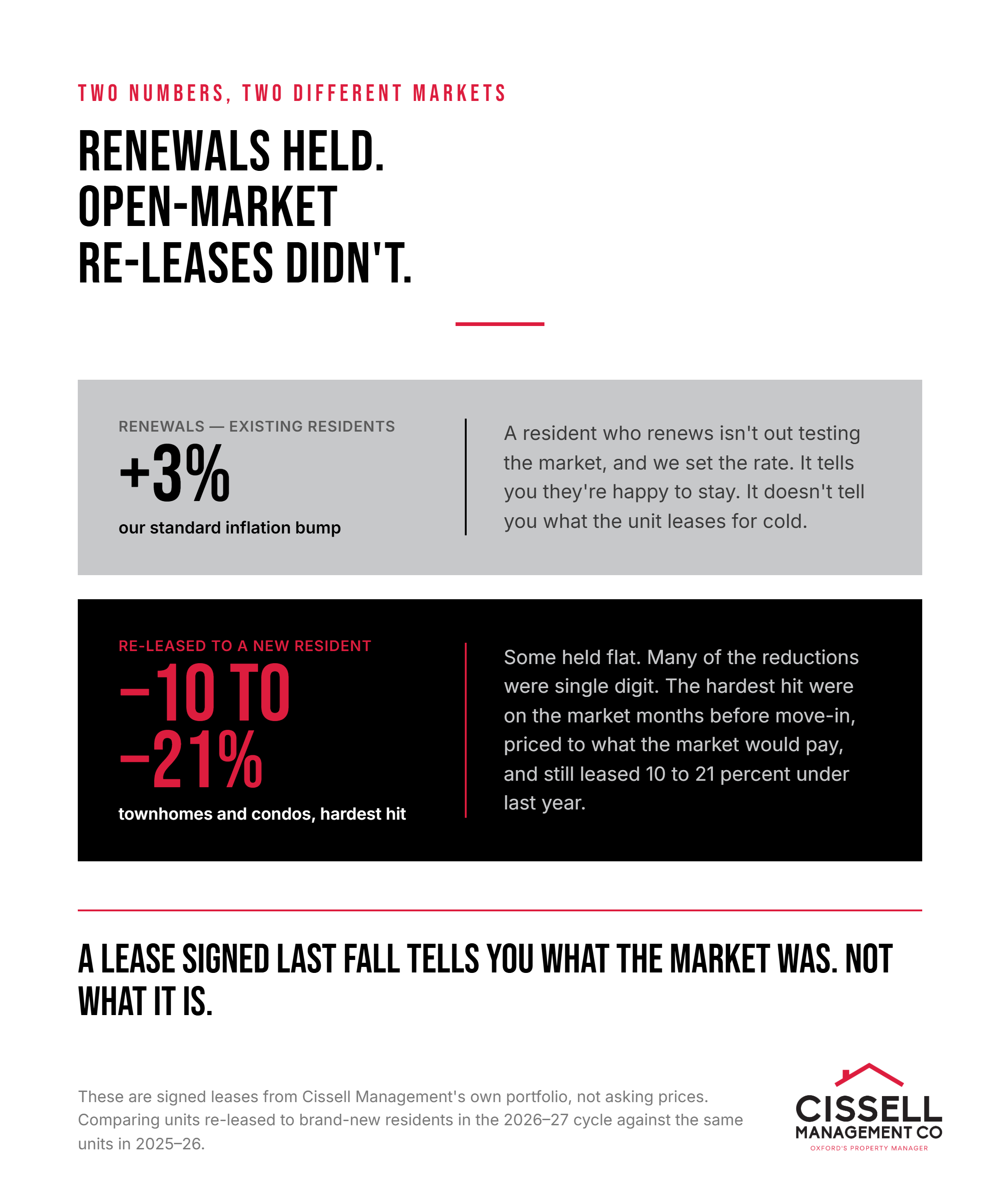
Start with the high numbers, since those are the ones people repeat. Renewals held. Ours went up about 3 percent, which is just our standard adjustment for inflation and not the market talking, and some owners pushed theirs up more than that last fall. So the rents on leases already signed look steady to high. That is the number you hear.
The catch is that a lease signed last fall, back when renters were still panicking that there was nothing left, or a resident renewing for another year, tells you what the market was, not what it is. It is a lagging number. A resident who renews is not out testing the market. They are staying in a home they like, and we set their rate, so it tells you they are happy to stay, not what the unit would lease for cold today. When a unit comes back to the open market today, you find out where rents stand now, and this year the answer was lower. The same backward look hides in the sales talk. A condo that went under contract last fall was a bet on last fall's market, not this one.
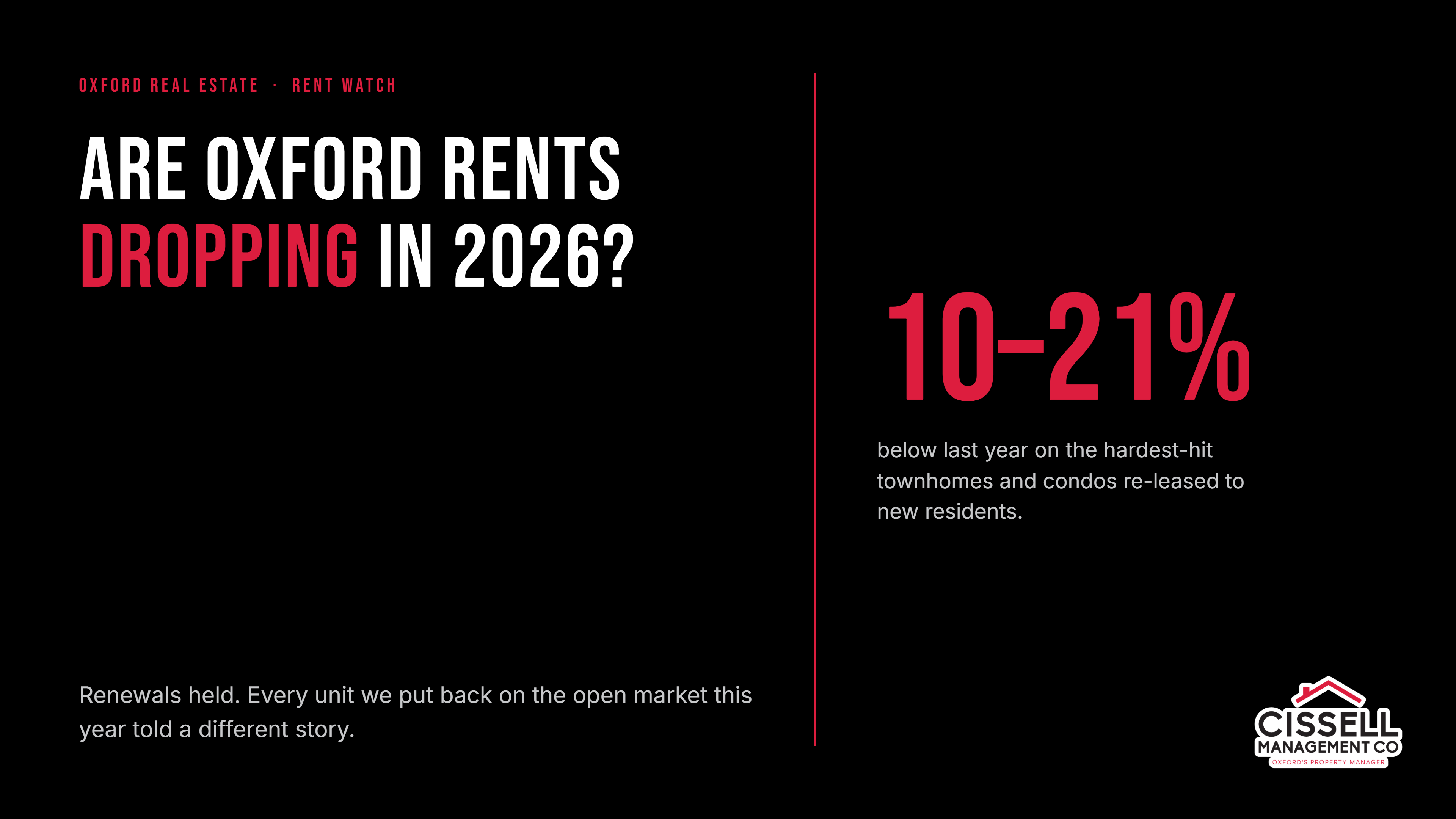
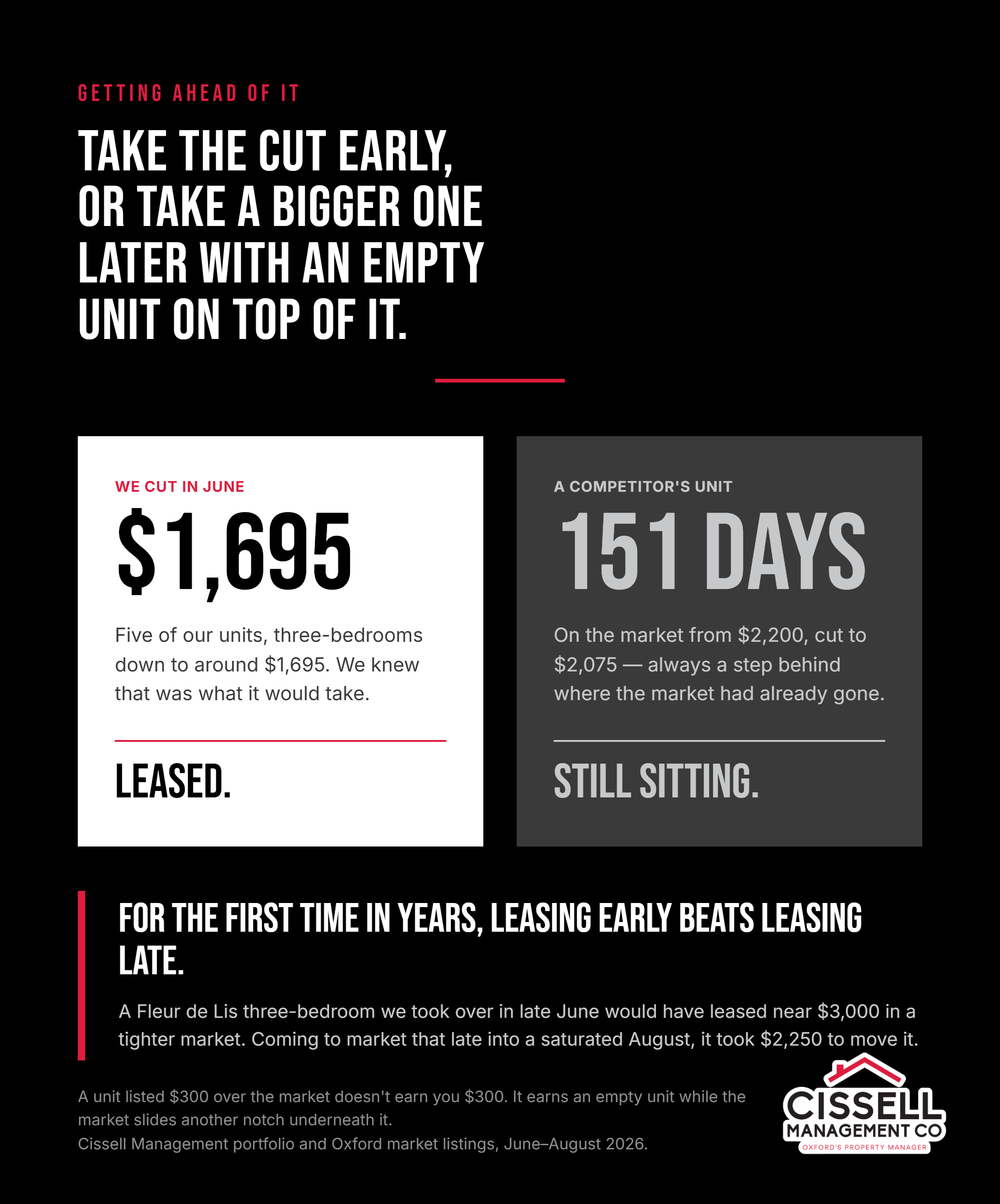
Across the units we re-leased to a brand-new resident this year, some held flat, many of the reductions were single digit, and the hardest-hit townhomes and condos fell 10 to 21 percent. Those hardest-hit units were not late-season fire sales. They were on the market months before the move-in, priced to what the market would pay, and they still leased 10 to 21 percent under last year, because that is how far the market for that product has fallen. Getting out ahead of it is why they leased at all. The owners still holding out for last year's rent are looking at a bigger cut later, with an empty unit on top of it. These are signed leases, not asking prices, and our own units.
So why do the high numbers hang on even with hundreds of units sitting empty? Because people follow the herd, and the herd is still living in 2022. Back in 2022 and 2023, housing here was tight, and people learned the hard way: grab a place early, pay what they ask, or go without, and it cost renters plenty, families stretching for a place because the town felt full. That lesson got burned in. Then it loosened. By 2024 there was a good bit more to choose from, and the supply has only grown since. The houses caught up a couple of years ago, and the fear is only now catching up to them. So people still act like there is nothing left, signing fast at a high number, when there are hundreds of units open and more on the way.
This is the year the pattern stops working, and you can see it in the fall leasing. Every year, managers advertise units early, in October and November, to pre-lease them for the next August, and in the tight years the fall panic was enough to clear those early listings fast. This past cycle it wasn't. So many managers pushed inventory out at once that even with renters still signing scared, a lot of it never pre-leased, and plenty of it is still sitting now. That is the belief breaking in plain numbers. The panic is still there, but there is finally too much supply for it to soak up, and a fear that cannot clear the market cannot hold prices up either.
What the drop looks like in dollars
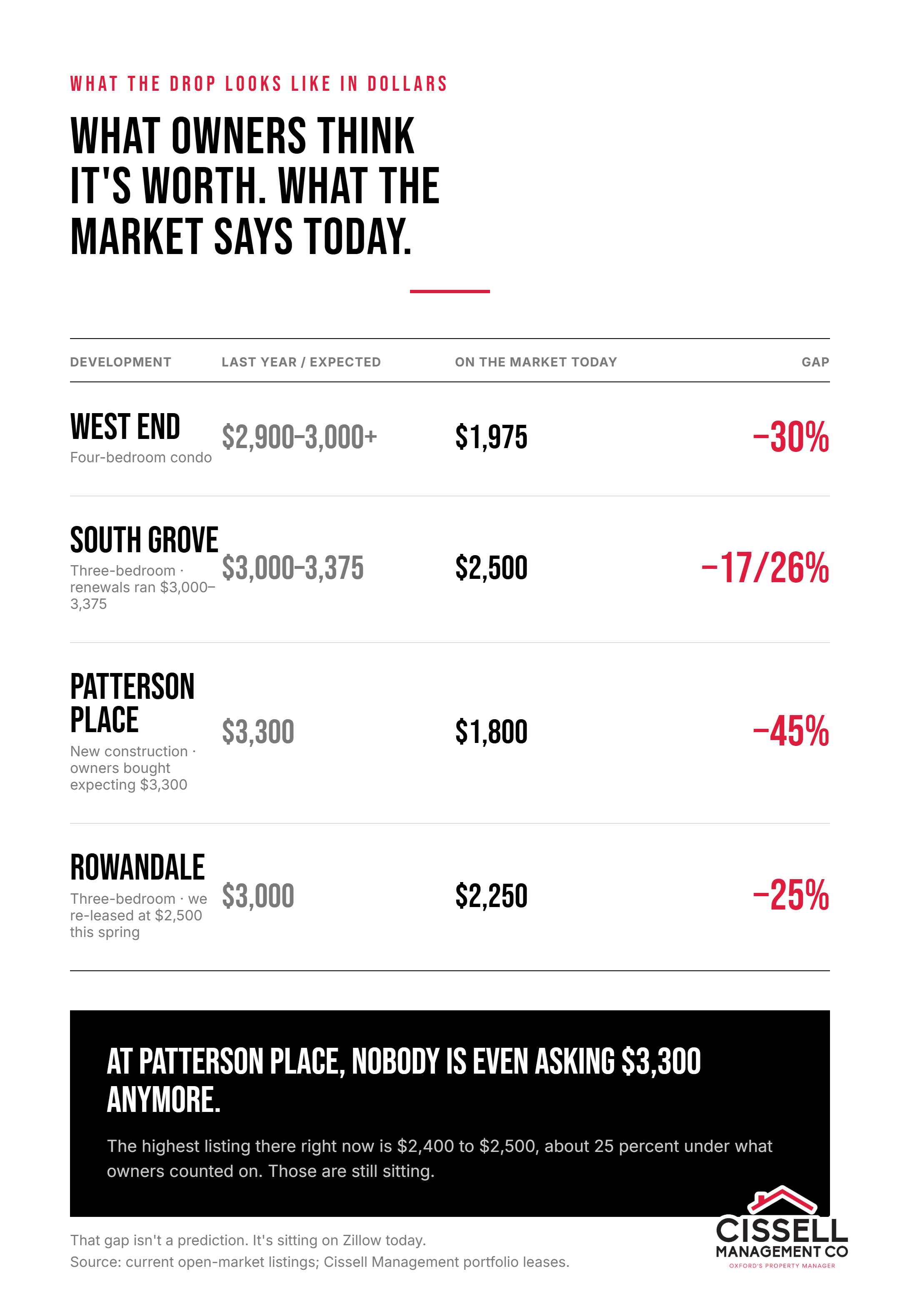
The gap between those two numbers is the whole story, and it is easiest to see in dollars.
Take a four-bedroom at West End, one of the condo developments in town. A year ago, four-bedrooms at West End were leasing anywhere from the high $2,000s to over $3,000. Today a comparable one is listing on the open market as low as $1,975, roughly 30 percent below where it was. Or a three-bedroom at South Grove. Ours renewed around $3,000, and a comparable one at Meadow Crest renewed at $3,375. On the open market today, the lowest a similar unit lists for is $2,500, which is 17 to 26 percent below those renewals. And over at Patterson Place, a comparable new-construction development, one unit sat at $2,000 without renting and dropped to $1,800 to lease it. A lot of the owners there bought expecting the units to rent for closer to $3,300, so that $1,800 is about 45 percent below what they counted on, and nobody is even asking $3,300 anymore. The highest anyone is listed at right now is $2,400 or $2,500, still about 25 percent under, and those are still sitting. What owners believe these units are worth and what the open market actually says it's worth are two different things.
That gap is not a prediction. It is sitting on Zillow today.
Getting ahead of the market
We got ahead of it. Back in June we cut the rent on five of our units, our three-bedrooms down to around $1,695. The comparable units around them were still listed higher and sitting, and we knew $1,695 was what it would take to get them leased. We took the cut early and we leased them. In the same stretch, a competitor's unit sat on the market for 151 days, cut from $2,200 down to $2,075 and still not leased, along with other units always a step behind where the market had already gone.
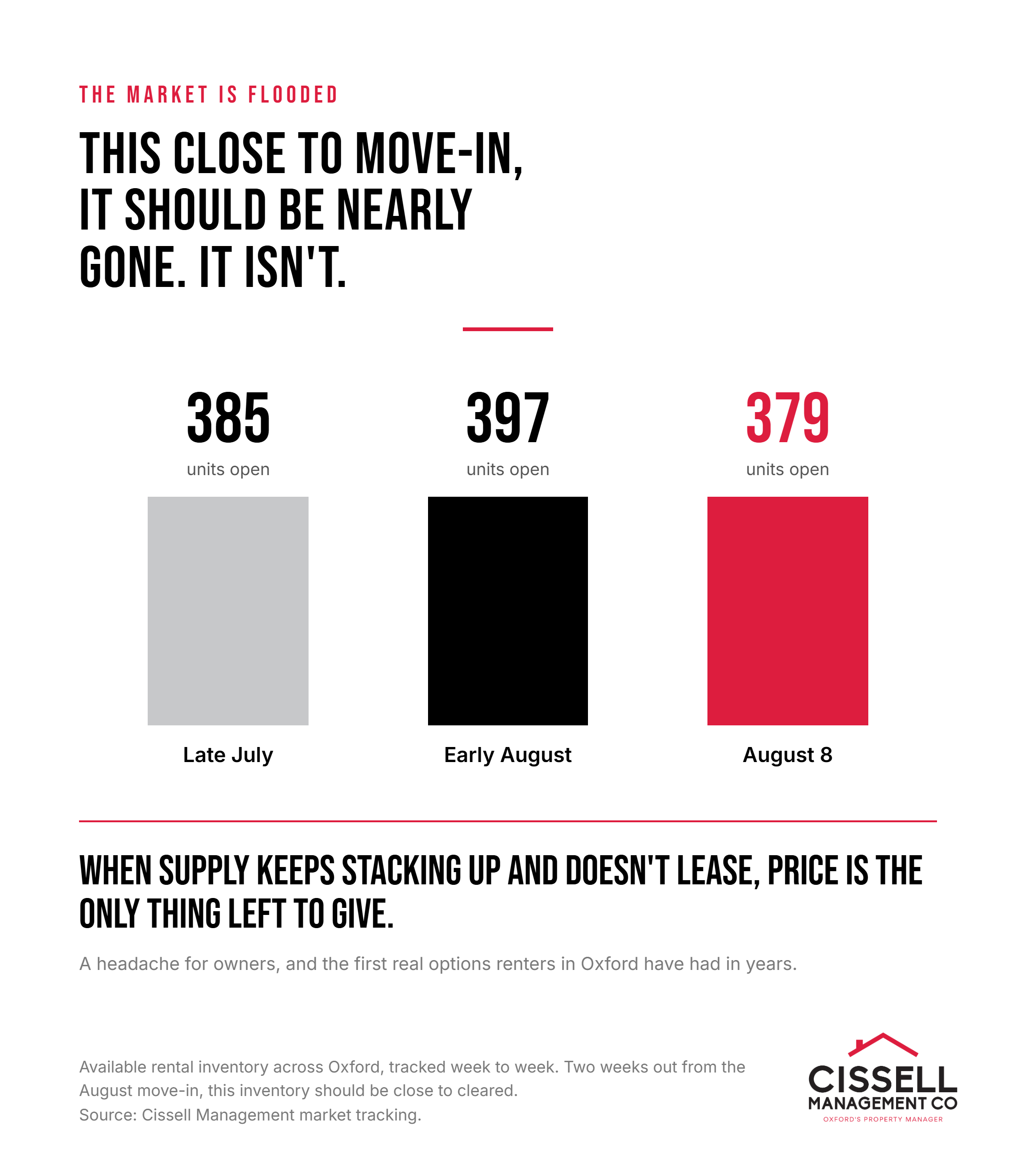
And it has kept sliding. We re-leased a Rowandale three-bedroom at $2,500 this spring, down about 17 percent from the $3,000 it brought a year earlier, which felt aggressive at the time. Today the market floor for that same three-bedroom is $2,250, a full 25 percent below last year's number. The available inventory across Oxford was around 385 units in late July, climbed to 397 in early August, and was still 379 on August 8. This close to move-in it should be nearly gone, and it is not, a headache for owners and the first options renters have had in years. When supply keeps stacking up and does not lease, price is the only thing left to give.
For the first time in years, leasing early beats leasing late. In the tight years it ran the other way: a unit held into late winter leased into the last of the inventory, and with so little left, those late units leased for the most, so the smart move was to hold for the late number. This year all of that flipped. A unit that comes to market on time settles somewhere in the middle, and a unit that comes late, into a flooded August, has to go to the bottom to move at all. We took over a three-bedroom condo at Fleur de Lis in late June. In a tighter market it would have leased for around $3,000. Coming to market that late with the market already saturated, we had to list it at $2,250 to get it leased. Priced right and early next season, a unit like that settles in between, not at rock bottom. But that middle only holds if supply stops growing, and it is not going to stop growing. With this many units still coming, even the in-between prices are likely to slide toward the bottom, and then past it.
There is a trap in that for owners. The natural reaction to a soft market is to make residents decide whether they are renewing earlier and earlier, so you can get the unit advertised sooner, and this year it worked, so next year even more owners will try it. But the calendar has run out of room. Owners are already pre-leasing in September and October, 11 months ahead of an August move-in, which means asking residents to renew barely 30 to 45 days after they move in. There is nowhere earlier left to go, short of forcing two-year leases. It also backfires, in two ways. Plenty of residents do not want to decide 11 months out whether they will stay, so the early ask pushes them out the door instead of locking them in. And the ones who do sign are committing before they know their own plans, so a share of those leases fall apart later and the unit has to be leased all over again. Prospective renters will stop cooperating too. Once they see the units are not going anywhere, they refuse to be rushed into signing early at a high number, and they wait to see where prices go instead. The early-lease advantage thins out the moment everyone is chasing it.
What this means if you own an Oxford rental
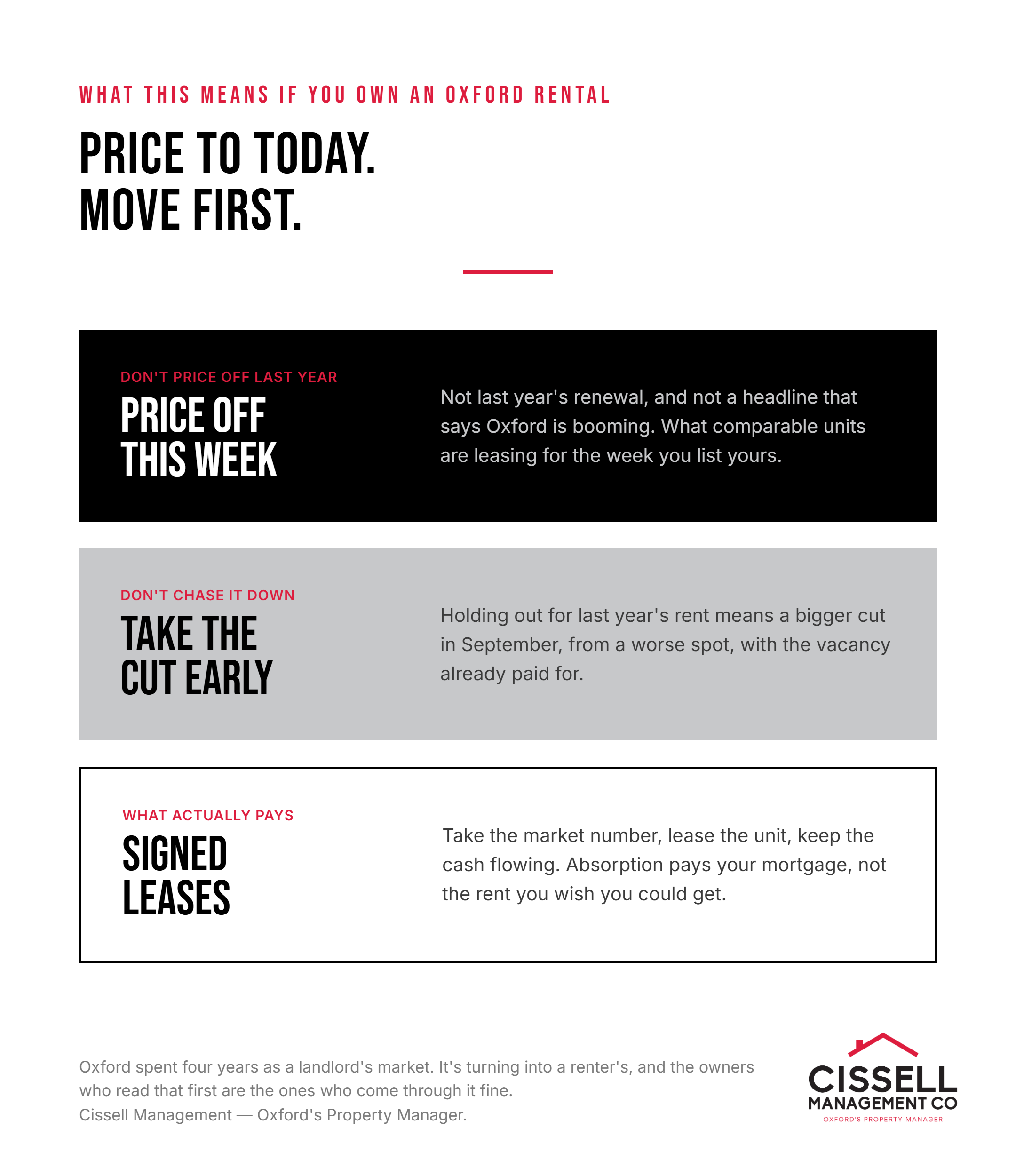
Do not price off last year's renewal, and do not price off a headline that says Oxford is booming. Price off what comparable units are leasing for the week you put yours on the market. A unit listed $300 over the market does not earn you $300. It earns you an empty unit while the market slides another notch underneath it, and then you cut anyway, later, from a worse spot. That is chasing the market down instead of getting ahead of it. The resident who pre-leases almost a year in advance at a high number is not proof the market is strong. It is proof they panicked before they checked.
The owners who do well in a market like this are the ones who move first. Take the market number, lease the unit, keep the cash flowing, and let the owner down the street be the one holding out for a higher number while the unit sits. Absorption is what pays your mortgage, not the rent you wish you could get.
Most of what I write is for owners, because that is who we represent and who we work for. But there is another side to this. For years renters in Oxford paid up out of fear there was nothing else to find, students and working families stretching for a place because the town felt full. If the market is finally loosening, that is relief a lot of them have needed, and it is good for Oxford. Owners carry the risk on the way down, and renters get a little breathing room, and both of those are true at the same time. Oxford spent four years as a landlord's market. It is turning into a renter's, and the owners who read that first are the ones who come through it fine.
This is where it matters who is managing the property. Watching this market is our job at Cissell Management, every day, all year, unit by unit, what is listed, what is leasing, and at what price. For the last four years, the market did the work for you. It was tight enough that an owner managing their own place could spend a few minutes online, price off whatever was nearby, and be fine. A sales agent running a few rentals on the side could do the same. This year it started costing them. The people without eyes on the market every day are the ones getting caught, holding out for last year's number, watching the unit sit, and losing money they did not have to lose.
We tell the owners we work for the truth about their rent, even when it is not what they want to hear. We make the move, and when the move is a lower rent, we make that call and tell you why. It is not because we gave up on the unit. The market already moved, and we would rather you hear it from us in June than see a vacant listing in September.